Visualizzazione post con etichetta italie. Mostra tutti i post

martedì 9 ottobre 2018

L'ACQUA : PETROLIO DEL FUTURO

L'acqua: 
petrolio del futuro.


E' noto che è una risorsa fondamentale per la vita di ogni organismo, siano essi vegetali o animali. Infatti, tutti gli esseri viventi sono composti in percentuale di acqua più o meno elevata.


Per il solo fatto che come risorsa è irrinunciabile, non va sprecata e va usata con intelligenza e con moderazione. 


Per l'uomo è una risorsa importantissima, e soprattutto fondamentale, perché senza questa risorsa la terra non potrebbe ospitare la vita. Pertanto, ogni processo vitale, animale o vegetale, sarebbe impossibile in assenza di acqua.  Dalle scoperte delle scienza e della storia, la vita ebbe origine nell'acqua circa 3.5 miliardi di anni fa e si diffuse sulle terre emerse solo 3 miliardi di anni più tardi.

Tuttavia, ancora oggi, l'insufficienza dell'acqua provoca morte di moltissime persone.

E' anche molto importante per tutte le attività connesse all'attività umana (dal settore primario (agricoltura) al secondario (industrie) e al terziario (servizi e il turismo).
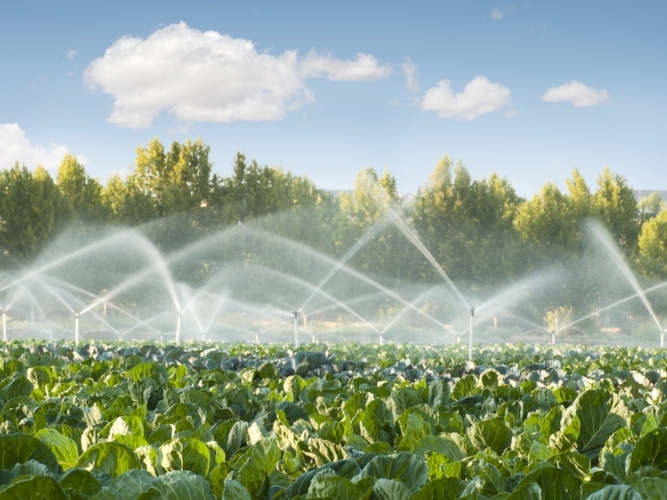

 ACQUA IN AGRICOLTURA


Risultati immagini per RISAIE PAVIA
RISAIE (PARCO LOMBARDO DEL PARCO DEL TICINO)


Risultati immagini per turismo fluviale italia navigli
TURISMO FLUVIALE : LA NAVIGAZIONE SUI NAVIGLI

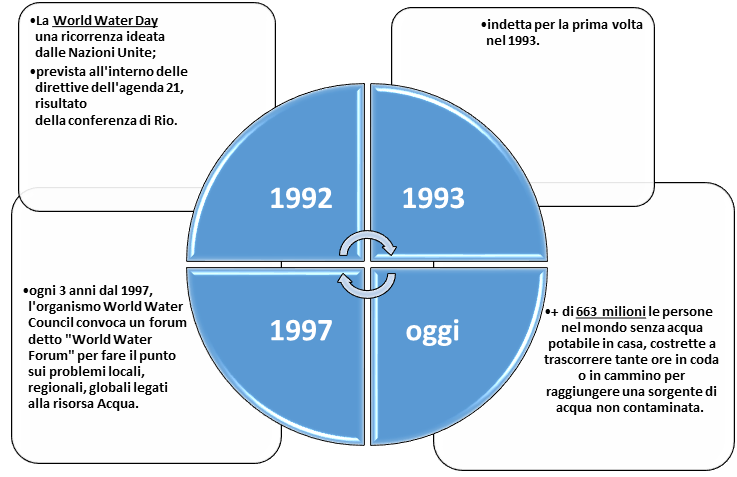
Per la sensibilizzare di tutti all'utilizzo e alla gestione in modo ottimale e sostenibile di questa grandiosa risorsa è nata la Giornata Mondiale dell'acqua, ogni 22 marzo detta la  World Water Day. 


Un pò di storia del World Water Day?


OBIETTIVO:

  • Richiamare l'opinione pubblica sull'importanza imprescindibile del bene primario per eccellenza
  • promuovere una gestione sostenibile della risorsa idrica.

Per capire quanto è particolare e delicato il ciclo dell'acqua occorre guardare il piccolo schema:


Qualche dato recente?

Secondo l’Onu, la domanda globale è cresciuta di sei volte negli ultimi 100 anni e continua ad aumentare al ritmo dell'1% ogni anno e pertanto, fra 30 anni il mondo potrebbe aver bisogno del 30% d'acqua in più rispetto a oggi. 

E' una risorsa quindi che è sempre di meno e per meno persone: stando all’ultimo report congiunto Oms-Unicef, circa il 30% della popolazione mondiale, pari a 2,1 miliardi di abitanti, non possiede nella propria abitazione un accesso continuato e sicuro all'acqua potabile.

L’edizione 2018 della Giornata mondiale dell’acqua ha come tema "Nature for Water" ovvero "La Natura per l’acqua" tenutosi in Brasile.

Si pone un'attenzione molto particolare sulle soluzioni che la Natura stessa offre per conservare e ripristinare il ciclo naturale dell’acqua, impedendo che vengano sprecate le risorse idriche del nostro pianeta. 

E' uno degli obiettivi fissati dopo l’approvazione dell’Agenda 2030 per lo sviluppo sostenibile, nel settembre del 2016. 

Un atro obiettivo è quello di "migliorare la qualità dell’acqua e diminuire l’inquinamento, eliminando gli scarichi, riducendo al minimo il rilascio di sostanze chimiche e materiali pericolosi, dimezzando la percentuale di acque reflue non trattate e aumentando il sano riciclaggio e riutilizzo globale entro il 2030", oppure - sempre entro il prossimi 12 anni - "ridurre in modo sostanziale la produzione di rifiuti attraverso la prevenzione, la riduzione, il riciclaggio e riutilizzo".

Cosa è importante sapere?


QUINDI:


L'acqua è un bene comune 

fondamentale per la vita.


Risultati immagini per foto acqua senza copyright per scopi commerciali


Questa risorsa è particolarmente scarsa nei paesi del sud del mondo sia per gli effetti dei mutamenti climatici, l'inquinamento, gli sprechi, sia perchè al centro di gravi tensioni sociali.

Dai dati raccolti nelle ricerche da Lega Ambiente, in Italia, mostrano come il tema della corretta gestione dell'acqua che, presenta varie criticità, sia ancora attuale, ci riguarda tutti in modo consapevole.

Pertanto occorre creare nella mente dei cittadini e delle imprese un senso civico e comune nel rispetto di questa preziosa risorsa. 


Bisogna ridurre gli sprechi, 

riutilizzare e non inquinare: 

con piccoli gesti quotidiani, 

tutti li possiamo fare e 

contribuire al risparmio  idrico.


Ogni italiano consuma in media 245 litri di acqua al giorno. 

Ogni volta aprendo il rubinetto di casa, l’acqua sgorga abbondante, come se non dovesse finire mai, dandoci l’idea che ci sia acqua per tutti.

Sfortunatamente, quasi nello stesso momento, nel mondo, ci sono 700 milioni di persone che non hanno facile accesso all’acqua potabile e circa la metà vive in Africa, in paesi come Nigeria, Etiopia, Tanzania, Repubblica democratica del Congo, Kenya, Sudan, Mozambico e, soprattutto, in Sud Africa.

Siamo molto fortunati a utilizzare questa grandiosa risorsa ma non c’è ne rendiamo conto.


Se all’improvviso le cose dovessero modificarsi? 
Se ci ritrovassimo a fare i conti con la necessità di razionare l’acqua? 
Saremmo capaci di cavarcela? 
Sapremmo vivere con una disponibilità minima di acqua 
per cucinare, pulire casa, lavarci, bere?


Gli scienziati hanno calcolato che entro il 2025 quasi due miliardi di persone vivranno il problema della scarsità idrica “assoluta”, ossia con una disponibilità sotto la soglia dei 500 m3 all’anno a testa.

Il 97,5% dell’acqua presente sulla terra è salata, quindi solo il 2,5% è dolce e, di questa, solo lo 0,1% è accessibile all’uomo.  

Per contro, la popolazione mondiale cresce a un ritmo superiore rispetto alla capacità della risorsa di rigenerarsi e rendersi disponibile.


PERTANTO


l'acqua è un bene limitato, 
non va dissipato e non va inquinato. 


Vorrei ribadire il concetto: 

NON VA SPRECATA, 
NEANCHE UNA GOCCIA.


Risultati immagini per foto acqua senza copyright per scopi commerciali

domenica 22 luglio 2018

Milano : La rotonda dalla Besana


Dove si trova?

Via Enrico Besana, 12

20122 Milano


La Rotonda della Besana trova accanto a Piazza Cinque Giornate, accanto ai Bastioni Spagnoli, nel tratto che da porta Vittoria si snoda verso porta Romana.

La Rotonda che viene chiamata da tutti "della Besana", è ubicata sull'omonima via ed è stata costruita nei primi anni del Settecento come cimitero del vicino ospedale Maggiore. 


È un complesso tardobarocco, completato fra il 1719 e il 1731 con la costruzione della chiesa di San Michele ai Nuovi Sepolcri, a croce greca che oggi è sconsacrata, e del porticato a segmenti d'arco in mattone a vista che la circonda. 

San Michele ai Sepolcri

In passato lo avevano chiamato "Foppone", cioè grande fossa.

L’area rimase in uso fino al 1782, quando l’Imperatore d’Austria Giuseppe II proibì le con una legge propria, di eseguire inumazioni entro le mura delle città dell’Impero Austro Ungarico, per questioni igienico-sanitarie.


Sotto il pavimento del portico si estendevano profonde cripte destinate ai morti dell’ospedale e si stima che in questo mezzo secolo avevano raggiunto le 150.000 unità.


Oggi la Rotonda è un'importante sede espositiva della città. 

Il suo complesso composto dalla Chiesa di San Michele ai Nuovi Sepolcri, fu costruita da Attilio Arrigoni tra il 1695 e il 1700 e il recinto porticato che la racchiude, fu progettato da Carlo Francesco Raffagno e terminato da Francesco Croce nel 1731. 


Il suddetto porticato è composto da un muro in laterizio (materiale artificiale da costruzione ottenuto dalla cottura di argille con quantità variabile di sabbia, ossido di ferro e carbonato di calcio) e con archi, Iesene e grandi finestroni.


E' caratterizzato da un percorso rialzato e continuo formato da quattro esedre maggiori alternate a  quattro esedre minori con colonne binate.


Il cimitero, chiuso alla fine del 700, fu interessato da alcuni progetti, uno dei quali prevedeva la trasformazione della Rotonda, in Pantheon del Regno Italico destinato ad accogliere le sepolture degli uomini illustri: ma questo progetto non fu mai realizzato.


Perchè visitare la Rotonda della Besana?


nel 1939 l’area fu ceduta al Comune che la restaurò, trasformandola in un’area verde pubblica utilizzata come spazio espositivo per mostre temporanee, proiezioni ed eventi culturali. 


Dal 2014 è sede del MUBA - Museo dei Bambini di Milano.


Alcune curiosità:


  • Molti pensano  che la Rotonda della Besana coincida con il Lazzaretto manzoniano, ma non è così: in quanto il lazzaretto citato nei Promessi Sposi coincide tra l’area compresa tra la chiesa di San Paolo al Lazzaretto e Corso Buenos Aire; mentre come abbiamo già detto la Besana si intende come l’ex cimitero seicentesco, extraurbano, e di pertinenza della Ca’Granda (l’Ospedale Maggiore di Milano). 
  • E’ Rotonda perché nel 1719 tutto il complesso venne cintato da un porticato, così da limitare il flusso delle acque dei Navigli che, nei periodi di piena, imputridivano la zona emanando un tanfo stomachevole e creando disagi alle bare non sepolte.
  • Enrico Besana nato a Milano nel 1813, fu un patriota e politico italiano, volontario e combatté, come garibaldino, nelle Guerre di Indipendenza combattute a Milano nel ’48. Ecco perché  la Rotonda è stata intitolata a lui come la piazza Cinque Giornate.

Infine, la Rotonda della Besana è stata usata come "‘lo’ spazio espositivo di Milano", di tanti artisti e architetti come Luigi Veronesi, Fabrizio De André e Karl Lagerfeld etc..


Alcune foto:


San Michele ai Sepolcri


Buona Visita

mercoledì 18 luglio 2018

the church of San Michele


Where is it?


Piazza S. Michele,  
27100 Pavia PV


TRAIN:

from
Milan Porta Garibaldi underground
to  
Pavia


Before telling the story of the Basilica, it is necessary to look at the   map   to better understand its structure.


The Basilica of San Michele   is one of the main churches of Pavia and is located in the historical center that dates back to the centuries   XI and XII   and is a masterpiece of Lombard Romanesque style.


The church is dedicated to San Michele Arcangelo and was built in the Lombard period.

In the Carolingian age it was entrusted to the monks of San Colombano di Bobbio and was used in official ceremonies.


In   Xth century   It is already remembered as a palatine seat, linked to the palace of the King, so much so that the first Lombard coin depicted the church of San Michele.

 The first building was destroyed by fire in the   1004   a few decades later the new church, rebuilt towards   the   1130 ,   completed within the year   1155   had an interruption due to the earthquake of the   03/01/1117.


In the Basilica of San Michele the fragile was used sandstone ocher color that had a Latin cross plan and a transept protruding from the rest of the building.


"Serena bifida" carved in sandstone,


on the right portal of the basilica

The basilica is 55 meters long, while the transept measuring 38 meters; at the intersection, then,   between the nave and the transept rises the dome of octagonal shape   on plumes of Lombard style.


View from the bottom of the octagonal dome
There   plant   Latin cross presents a division in   3 naves , each of which opens with a front door.


 There facade it is adorned with sacred and also secular sandstone sculptures.

Today unfortunately deteriorated by weathering, despite a conservative restoration of the last decades.

Above the central portal , it stands out   the owner of the basilica,  
San Michele, which tramples the dragon.


There are many in the major façade   bas-reliefs and sculptures , which contain a symbolism that is difficult to decode in the original intent.


In   transept   we admire   there   cross and the Crucifix   of silver foil,  restored in 2002.

Crucifix in silver foil   The crucifix of Theodote   ( 10th century).  

As soon as we enter the Basilica we notice the icon of San Michele


 The  presbytery is raised compared to the assembly (two steps lower than the choir).   
From here you can admire, the fresco with The coronation of the Virgin.


On the beam the Crucifix   and the sorrowful figures of the Virgin and of John are the work of Urbanino da Surso (second half of the fifteenth century).  


The great "majesty " in the form of a gilded temple is from 1606.  
With a central plan, it is articulated on three levels, with balconies, niches and statues.


The altar   rectangular marble is from 1383.  
In 1580 it was removed from its original location and moved forward.  
It covered the admirable mosaic and a labyrinth.  
Therefore, thanks to what a part would have saved.


the altar

Adjacent to the altar we can see the   Wooden shovel  
by Giacomo and Giovan Angelo del Maino (XV century):


The biblical capital more famous and known as "The death of the righteous".

In the famous Death of the just San Michele, represented in the role of companion of souls (psychopomp), with the spear keeps the devil at bay to which it subtracts the soul of the righteous (in the form of a child) to transport it to Paradise.


Biblical capital: the death of the just
These lie, now dead and with their arms crossed in sign of the peace and quiet that can be seen even in the face, on the bed with two columns worked, visible; the blanket, with beautiful folds, goes down almost to the ground, as we shall see shortly, in a precious fresco. The soul, now out of the body, is in the shape of a little boy who, with his arm, clings to the neck of the winged Archangel Saint Michael, who suddenly appeared to pierce, with his shaft, right in his mouth , the devil also winged, but tricornuto , caudato and from the claws of uccellaccio; which little devil had already grasped the little boy by the leg, claiming it as a greedy prey. But in vain: Michele will succeed victoriously from the struggle and, as a "psychopomp" or a companion of souls, will bring the soul of the Righteous to Heaven.


Some photos of the interior:


Chapel "VITA DI MARIA" - Madonna between San Sebastiano and San Rocco
(Moncalcalvo 1601 on Pala) 

It is interesting   crypt,   of square plan, which    it extends under the presbytery and the apse and is divided into two aisles with two rows of six columns.  
According to historians, the capitals date back mostly to the 12th century, although some probably belonged to the crypt of the previous church (9th century).


At the bottom of the crypt, there is the   TREASURE OF SAN BRIZIO
(by the Associazione Amici dei Musei Pavesi)
from   2007-2013.


Curiosity :  
The Church of San Michele is called 
the church of the Kings:


The Basilica of San Michele was born over time as a sacred building destined for the coronations of the kings who were crowned as Italic kings from 925 to about half of 1150 (9th-12th centuries).

For example we can remember, Henry II called "The Saint" (1004) and the  King of Italy by Federico Barbarossa, May 17, 1155 at the age of 32.


The church used its part   transversal   and  King from the courtyard to the main door.


The Basilica was designed as one   great scenic machine , to accommodate, even with   light effects e   of adequate sonorities, the complex ritual of coronations.


We can see are the ruins of the original facade.
In fact, there are many traces left, so that the cross section of the church is subdivided on   2 floors   with a wooden deck.

The church is of medieval origin and is linked to the symbols of the royal coronation.
 In front of the altar, in the most sacred part of the church we find  the image of the   labyrinth   surrounded by figures and animals that repeat the constellations of the sky.

The   labyrinth   it is often the symbol of the difficult and laborious search for man and his journey through the mysteries of life.


In the presbytery, the place of the altar, raised above the plane of the naves, the floor was covered with a large mosaic


The floor maze of the San Michele is accompanied, on the sides of the circular route, the symbols of the earth, the sea, the sky, the man.

The year is depicted as a crowned king, at the center of the flow of the months and seasons.
Therefore, there were represented 12 months,   of which only half remain.
To the center, then, there is the image of the year and the crown on the head, always as a reference to royalty.

THE PAVIMENTAL MOSAIC OF THE PRESBYTERY - BASILICA OF SAN MICHELE  
From the picture below, it can be seen that those who have restored have left 
the circular strips of the maze :


  There  reconstruction   more accurate   and reliable of the presbyteral mosaic   del San Michele is the work of   Maurizio Costa   (1980-84) that comes from the analysis residual fragments and their integration, through known archival drawings.  
Therefore, you can not place   some residual fragment, in the overall picture of the reconstruction.


 The floor mosaic of the presbytery of San Michele,  
in its entirety (reconstruction by Maurizio Costa).  

Recall to the regality that is repeated in the center of the apsidal cup with Christ crowning the Virgin.

The church was designed as bright scenic car .

The window, where Saint Michael is depicted, illuminates with precision, only on certain days of the year the front niche.

In the precise days of the coronations, in the first day of the month of   May , the light that falls from the high window of the dome had to illuminate the head of the King in the moment in which it presented itself to the people and the Year-King of the mosaic.


The place where, according to tradition, the king's coronation was to take place, is marked by   five marble circles . The central circle was redone during the nineteenth century restorations.

In it was written the Latin inscription that refers to the ceremony


THE 5 MARBLE DISKS,  CROSSING POINT

Towards the exit, one can observe the SANT'ANNA CHAPEL  
where there is one Pala of the seventeenth century :


Sacra Famiglia e Sant'Anna - Pietro de Pietri da Prema.

Enjoy your visit